1. Abterra
- Weekly Chart : inconclusive ??
- Daily Chart : trending down. Sell at rebound resistance or buy at reversal ??
2. AIMS
- Weekly Chart : trend is going down. Wait for rebound and sell at resistance at $0.225 -ve
- Daily Chart : Possible downtrend -ve
3. Annica
- Weekly Chart : near bottom. Waiting for reversal +ve
- Daily Chart : possible reversal +ve
- Corporate Action : Private placement -ve
4. China Sports
- Weekly Chart : near bottom. Waiting for reversal +ve
- Daily Chart : possible reversal +ve
- Corporate Action : Loss of FIFA distribution rights
5. Eunetworks
- Weekly Chart : near bottom. Waiting for reversal +ve
- Daily Chart : sideways
- Corporate Action : Grant share option below market price
6. LippoMapleT
- Weekly Chart : Uptrend. near support. Buy at 0.505 +ve
- Daily Chart : sideways
7. Penguin
- Weekly Chart : Near Reversal +ve
- Daily Chart : Uptrend. Buy at reboundat 0.11 +ve
8. Raffles Edu
- Weekly Chart : Near Reversal +ve
- Daily Chart : Near Reversal +ve
- Corporate Action : Poor Quarterly results. Opening of new academy. Daily share buyback.
4. China Sports
- Weekly Chart : near bottom. Waiting for reversal +ve
- Daily Chart : possible reversal +ve
- Corporate Action :Terminatation of FIFA distribution rights -ve
5. Eunetworks
- Weekly Chart : near bottom. Waiting for reversal +ve
- Daily Chart : sideways
6. LippoMapleT
- Weekly Chart : Uptrend. At support. Buy at 0.505 +ve
- Daily Chart : sideways
Thursday, December 16, 2010

Tuesday, December 14, 2010
How to Deal with Insurance Agents
How to deal with insurance agents?
1.The first sign is if the agent starts telling you how good his or her whole life product is, you better run as fast as you can. This is the product pusher that you shouldn't trust. He or she is not going to care whether your needs are met or not as long his or hers is.
2.If the agent tells that it is required by law to fill up some form details and appears to conduct something that looks like need analysis but recommends you a whole life with sum assured far short of the analysis you can also run as fast as you can. Or if he or she tells you can buy the short fall some other time and if you hear this you can shoot off like a bullet and never turn back.
3.If the agent asks if you have budget for the insurance and starts to generate a quotation for you based on the budget you give him or her you can write him or her off. This is another product pusher that appears only to meet your budget.
4. If the agent meets you with a few quotations with different amount of sum assured, this is yet another product pusher. This agent is offering you different models.You have to find out YOURSELF which suits you. You are the adviser yourself.
5.If the meeting place is your home and the agent brings some food or gift for your children the agents intends to induce or to make you 'paisay' so that you will buy out of obligation and not for financial reason.
6.If the an agent tells how sincere or caring she is you can be sure that your financial life will be disastrous..
7.If a woman agent sits too near to be comfortable you can be sure the outcome is not due to financial needs that you buy.
8.If an agent takes out a newspaper cutting to highlight the threat of illness he or she is indeed threatening you to buy and if not they will curse you.
9.If the agent tells the company is having a gift promotion he or she is trying to test your greed and your reason to buy is greed and not financial needs.
10.If the agent shows you the MDRT or COT or TOT logo on his or her name card quickly clutch your money purse or credit and run because they are thieves. The logos are actually MDRThief, COThief or TOThief. These thieves sell only whole life , endowment or regular ILPs which earn them very high commission to earn these logos.
11. Never ,never buy from your brother or sister or your relatives or from your friends because you are the insurance agent's guinea pigs and he or she is practicing on you and you WILL NEVER GET THE RIGHT ADVICE AND PRODUCT.
12.Treat all insurance as suspects and ask them for thier experience, their credentials and whether they are honest. honest? hear what they have to say.
The above are some tips and signs to look out for if you are dealing with insurance agents.Remember they are chameleon. They can camouflage . They are graduates from some drama schools.
Extract from here.
1.The first sign is if the agent starts telling you how good his or her whole life product is, you better run as fast as you can. This is the product pusher that you shouldn't trust. He or she is not going to care whether your needs are met or not as long his or hers is.
2.If the agent tells that it is required by law to fill up some form details and appears to conduct something that looks like need analysis but recommends you a whole life with sum assured far short of the analysis you can also run as fast as you can. Or if he or she tells you can buy the short fall some other time and if you hear this you can shoot off like a bullet and never turn back.
3.If the agent asks if you have budget for the insurance and starts to generate a quotation for you based on the budget you give him or her you can write him or her off. This is another product pusher that appears only to meet your budget.
4. If the agent meets you with a few quotations with different amount of sum assured, this is yet another product pusher. This agent is offering you different models.You have to find out YOURSELF which suits you. You are the adviser yourself.
5.If the meeting place is your home and the agent brings some food or gift for your children the agents intends to induce or to make you 'paisay' so that you will buy out of obligation and not for financial reason.
6.If the an agent tells how sincere or caring she is you can be sure that your financial life will be disastrous..
7.If a woman agent sits too near to be comfortable you can be sure the outcome is not due to financial needs that you buy.
8.If an agent takes out a newspaper cutting to highlight the threat of illness he or she is indeed threatening you to buy and if not they will curse you.
9.If the agent tells the company is having a gift promotion he or she is trying to test your greed and your reason to buy is greed and not financial needs.
10.If the agent shows you the MDRT or COT or TOT logo on his or her name card quickly clutch your money purse or credit and run because they are thieves. The logos are actually MDRThief, COThief or TOThief. These thieves sell only whole life , endowment or regular ILPs which earn them very high commission to earn these logos.
11. Never ,never buy from your brother or sister or your relatives or from your friends because you are the insurance agent's guinea pigs and he or she is practicing on you and you WILL NEVER GET THE RIGHT ADVICE AND PRODUCT.
12.Treat all insurance as suspects and ask them for thier experience, their credentials and whether they are honest. honest? hear what they have to say.
The above are some tips and signs to look out for if you are dealing with insurance agents.Remember they are chameleon. They can camouflage . They are graduates from some drama schools.
Extract from here.
Monday, December 13, 2010


Transcript of Commencement Speech at Stanford given by Steve Jobs
Thank you. I'm honored to be with you today for your commencement from one of the finest universities in the world. Truth be told, I never graduated from college and this is the closest I've ever gotten to a college graduation.
Today I want to tell you three stories from my life. That's it. No big deal. Just three stories. The first story is about connecting the dots.
I dropped out of Reed College after the first six months but then stayed around as a drop-in for another eighteen months or so before I really quit. So why did I drop out? It started before I was born. My biological mother was a young, unwed graduate student, and she decided to put me up for adoption. She felt very strongly that I should be adopted by college graduates, so everything was all set for me to be adopted at birth by a lawyer and his wife, except that when I popped out, they decided at the last minute that they really wanted a girl. So my parents, who were on a waiting list, got a call in the middle of the night asking, "We've got an unexpected baby boy. Do you want him?" They said, "Of course." My biological mother found out later that my mother had never graduated from college and that my father had never graduated from high school. She refused to sign the final adoption papers. She only relented a few months later when my parents promised that I would go to college.
This was the start in my life. And seventeen years later, I did go to college, but I naïvely chose a college that was almost as expensive as Stanford, and all of my working-class parents' savings were being spent on my college tuition. After six months, I couldn't see the value in it. I had no idea what I wanted to do with my life, and no idea of how college was going to help me figure it out, and here I was, spending all the money my parents had saved their entire life. So I decided to drop out and trust that it would all work out OK. It was pretty scary at the time, but looking back, it was one of the best decisions I ever made. The minute I dropped out, I could stop taking the required classes that didn't interest me and begin dropping in on the ones that looked far more interesting.
It wasn't all romantic. I didn't have a dorm room, so I slept on the floor in friends' rooms. I returned Coke bottles for the five-cent deposits to buy food with, and I would walk the seven miles across town every Sunday night to get one good meal a week at the Hare Krishna temple. I loved it. And much of what I stumbled into by following my curiosity and intuition turned out to be priceless later on. Let me give you one example.
Reed College at that time offered perhaps the best calligraphy instruction in the country. Throughout the campus every poster, every label on every drawer was beautifully hand-calligraphed. Because I had dropped out and didn't have to take the normal classes, I decided to take a calligraphy class to learn how to do this. I learned about serif and sans-serif typefaces, about varying the amount of space between different letter combinations, about what makes great typography great. It was beautiful, historical, artistically subtle in a way that science can't capture, and I found it fascinating.
None of this had even a hope of any practical application in my life. But ten years later when we were designing the first Macintosh computer, it all came back to me, and we designed it all into the Mac. It was the first computer with beautiful typography. If I had never dropped in on that single course in college, the Mac would have never had multiple typefaces or proportionally spaced fonts, and since Windows just copied the Mac, it's likely that no personal computer would have them.
If I had never dropped out, I would have never dropped in on that calligraphy class and personals computers might not have the wonderful typography that they do.
Of course it was impossible to connect the dots looking forward when I was in college, but it was very, very clear looking backwards 10 years later. Again, you can't connect the dots looking forward. You can only connect them looking backwards, so you have to trust that the dots will somehow connect in your future. You have to trust in something--your gut, destiny, life, karma, whatever--because believing that the dots will connect down the road will give you the confidence to follow your heart, even when it leads you off the well-worn path, and that will make all the difference.
My second story is about love and loss. I was lucky. I found what I loved to do early in life. Woz and I started Apple in my parents' garage when I was twenty. We worked hard and in ten years, Apple had grown from just the two of us in a garage into a $2 billion company with over 4,000 employees. We'd just released our finest creation, the Macintosh, a year earlier, and I'd just turned thirty, and then I got fired. How can you get fired from a company you started? Well, as Apple grew, we hired someone who I thought was very talented to run the company with me, and for the first year or so, things went well. But then our visions of the future began to diverge, and eventually we had a falling out. When we did, our board of directors sided with him, and so at thirty, I was out, and very publicly out. What had been the focus of my entire adult life was gone, and it was devastating. I really didn't know what to do for a few months. I felt that I had let the previous generation of entrepreneurs down, that I had dropped the baton as it was being passed to me. I met with David Packard and Bob Noyce and tried to apologize for screwing up so badly. I was a very public failure and I even thought about running away from the Valley. But something slowly began to dawn on me. I still loved what I did. The turn of events at Apple had not changed that one bit. I'd been rejected but I was still in love. And so I decided to start over.
I didn't see it then, but it turned out that getting fired from Apple was the best thing that could have ever happened to me. The heaviness of being successful was replaced by the lightness of being a beginner again, less sure about everything. It freed me to enter one of the most creative periods in my life. During the next five years I started a company named NeXT, another company named Pixar and fell in love with an amazing woman who would become my wife. Pixar went on to create the world's first computer-animated feature film, "Toy Story," and is now the most successful animation studio in the world.
In a remarkable turn of events, Apple bought NeXT and I returned to Apple and the technology we developed at NeXT is at the heart of Apple's current renaissance, and Lorene and I have a wonderful family together.
I'm pretty sure none of this would have happened if I hadn't been fired from Apple. It was awful-tasting medicine but I guess the patient needed it. Sometimes life's going to hit you in the head with a brick. Don't lose faith. I'm convinced that the only thing that kept me going was that I loved what I did. You've got to find what you love, and that is as true for work as it is for your lovers. Your work is going to fill a large part of your life, and the only way to be truly satisfied is to do what you believe is great work, and the only way to do great work is to love what you do. If you haven't found it yet, keep looking, and don't settle. As with all matters of the heart, you'll know when you find it, and like any great relationship it just gets better and better as the years roll on. So keep looking. Don't settle.
My third story is about death. When I was 17 I read a quote that went something like "If you live each day as if it was your last, someday you'll most certainly be right." It made an impression on me, and since then, for the past 33 years, I have looked in the mirror every morning and asked myself, "If today were the last day of my life, would I want to do what I am about to do today?" And whenever the answer has been "no" for too many days in a row, I know I need to change something. Remembering that I'll be dead soon is the most important thing I've ever encountered to help me make the big choices in life, because almost everything--all external expectations, all pride, all fear of embarrassment or failure--these things just fall away in the face of death, leaving only what is truly important. Remembering that you are going to die is the best way I know to avoid the trap of thinking you have something to lose. You are already naked. There is no reason not to follow your heart.
About a year ago, I was diagnosed with cancer. I had a scan at 7:30 in the morning and it clearly showed a tumor on my pancreas. I didn't even know what a pancreas was. The doctors told me this was almost certainly a type of cancer that is incurable, and that I should expect to live no longer than three to six months. My doctor advised me to go home and get my affairs in order, which is doctors' code for "prepare to die." It means to try and tell your kids everything you thought you'd have the next ten years to tell them, in just a few months. It means to make sure that everything is buttoned up so that it will be as easy as possible for your family. It means to say your goodbyes.
I lived with that diagnosis all day. Later that evening I had a biopsy where they stuck an endoscope down my throat, through my stomach into my intestines, put a needle into my pancreas and got a few cells from the tumor. I was sedated but my wife, who was there, told me that when they viewed the cells under a microscope, the doctor started crying, because it turned out to be a very rare form of pancreatic cancer that is curable with surgery. I had the surgery and, thankfully, I am fine now.
This was the closest I've been to facing death, and I hope it's the closest I get for a few more decades. Having lived through it, I can now say this to you with a bit more certainty than when death was a useful but purely intellectual concept. No one wants to die, even people who want to go to Heaven don't want to die to get there, and yet, death is the destination we all share. No one has ever escaped it. And that is as it should be, because death is very likely the single best invention of life. It's life's change agent; it clears out the old to make way for the new. right now, the new is you. But someday, not too long from now, you will gradually become the old and be cleared away. Sorry to be so dramatic, but it's quite true. Your time is limited, so don't waste it living someone else's life. Don't be trapped by dogma, which is living with the results of other people's thinking. Don't let the noise of others' opinions drown out your own inner voice, heart and intuition. They somehow already know what you truly want to become. Everything else is secondary.
When I was young, there was an amazing publication called The Whole Earth Catalogue, which was one of the bibles of my generation. It was created by a fellow named Stuart Brand not far from here in Menlo Park, and he brought it to life with his poetic touch. This was in the late Sixties, before personal computers and desktop publishing, so it was all made with typewriters, scissors, and Polaroid cameras. it was sort of like Google in paperback form thirty-five years before Google came along. I was idealistic, overflowing with neat tools and great notions. Stuart and his team put out several issues of the The Whole Earth Catalogue, and then when it had run its course, they put out a final issue. It was the mid-Seventies and I was your age. On the back cover of their final issue was a photograph of an early morning country road, the kind you might find yourself hitchhiking on if you were so adventurous. Beneath were the words, "Stay hungry, stay foolish." It was their farewell message as they signed off. "Stay hungry, stay foolish." And I have always wished that for myself, and now, as you graduate to begin anew, I wish that for you. Stay hungry, stay foolish.
Thank you all, very much.
Today I want to tell you three stories from my life. That's it. No big deal. Just three stories. The first story is about connecting the dots.
I dropped out of Reed College after the first six months but then stayed around as a drop-in for another eighteen months or so before I really quit. So why did I drop out? It started before I was born. My biological mother was a young, unwed graduate student, and she decided to put me up for adoption. She felt very strongly that I should be adopted by college graduates, so everything was all set for me to be adopted at birth by a lawyer and his wife, except that when I popped out, they decided at the last minute that they really wanted a girl. So my parents, who were on a waiting list, got a call in the middle of the night asking, "We've got an unexpected baby boy. Do you want him?" They said, "Of course." My biological mother found out later that my mother had never graduated from college and that my father had never graduated from high school. She refused to sign the final adoption papers. She only relented a few months later when my parents promised that I would go to college.
This was the start in my life. And seventeen years later, I did go to college, but I naïvely chose a college that was almost as expensive as Stanford, and all of my working-class parents' savings were being spent on my college tuition. After six months, I couldn't see the value in it. I had no idea what I wanted to do with my life, and no idea of how college was going to help me figure it out, and here I was, spending all the money my parents had saved their entire life. So I decided to drop out and trust that it would all work out OK. It was pretty scary at the time, but looking back, it was one of the best decisions I ever made. The minute I dropped out, I could stop taking the required classes that didn't interest me and begin dropping in on the ones that looked far more interesting.
It wasn't all romantic. I didn't have a dorm room, so I slept on the floor in friends' rooms. I returned Coke bottles for the five-cent deposits to buy food with, and I would walk the seven miles across town every Sunday night to get one good meal a week at the Hare Krishna temple. I loved it. And much of what I stumbled into by following my curiosity and intuition turned out to be priceless later on. Let me give you one example.
Reed College at that time offered perhaps the best calligraphy instruction in the country. Throughout the campus every poster, every label on every drawer was beautifully hand-calligraphed. Because I had dropped out and didn't have to take the normal classes, I decided to take a calligraphy class to learn how to do this. I learned about serif and sans-serif typefaces, about varying the amount of space between different letter combinations, about what makes great typography great. It was beautiful, historical, artistically subtle in a way that science can't capture, and I found it fascinating.
None of this had even a hope of any practical application in my life. But ten years later when we were designing the first Macintosh computer, it all came back to me, and we designed it all into the Mac. It was the first computer with beautiful typography. If I had never dropped in on that single course in college, the Mac would have never had multiple typefaces or proportionally spaced fonts, and since Windows just copied the Mac, it's likely that no personal computer would have them.
If I had never dropped out, I would have never dropped in on that calligraphy class and personals computers might not have the wonderful typography that they do.
Of course it was impossible to connect the dots looking forward when I was in college, but it was very, very clear looking backwards 10 years later. Again, you can't connect the dots looking forward. You can only connect them looking backwards, so you have to trust that the dots will somehow connect in your future. You have to trust in something--your gut, destiny, life, karma, whatever--because believing that the dots will connect down the road will give you the confidence to follow your heart, even when it leads you off the well-worn path, and that will make all the difference.
My second story is about love and loss. I was lucky. I found what I loved to do early in life. Woz and I started Apple in my parents' garage when I was twenty. We worked hard and in ten years, Apple had grown from just the two of us in a garage into a $2 billion company with over 4,000 employees. We'd just released our finest creation, the Macintosh, a year earlier, and I'd just turned thirty, and then I got fired. How can you get fired from a company you started? Well, as Apple grew, we hired someone who I thought was very talented to run the company with me, and for the first year or so, things went well. But then our visions of the future began to diverge, and eventually we had a falling out. When we did, our board of directors sided with him, and so at thirty, I was out, and very publicly out. What had been the focus of my entire adult life was gone, and it was devastating. I really didn't know what to do for a few months. I felt that I had let the previous generation of entrepreneurs down, that I had dropped the baton as it was being passed to me. I met with David Packard and Bob Noyce and tried to apologize for screwing up so badly. I was a very public failure and I even thought about running away from the Valley. But something slowly began to dawn on me. I still loved what I did. The turn of events at Apple had not changed that one bit. I'd been rejected but I was still in love. And so I decided to start over.
I didn't see it then, but it turned out that getting fired from Apple was the best thing that could have ever happened to me. The heaviness of being successful was replaced by the lightness of being a beginner again, less sure about everything. It freed me to enter one of the most creative periods in my life. During the next five years I started a company named NeXT, another company named Pixar and fell in love with an amazing woman who would become my wife. Pixar went on to create the world's first computer-animated feature film, "Toy Story," and is now the most successful animation studio in the world.
In a remarkable turn of events, Apple bought NeXT and I returned to Apple and the technology we developed at NeXT is at the heart of Apple's current renaissance, and Lorene and I have a wonderful family together.
I'm pretty sure none of this would have happened if I hadn't been fired from Apple. It was awful-tasting medicine but I guess the patient needed it. Sometimes life's going to hit you in the head with a brick. Don't lose faith. I'm convinced that the only thing that kept me going was that I loved what I did. You've got to find what you love, and that is as true for work as it is for your lovers. Your work is going to fill a large part of your life, and the only way to be truly satisfied is to do what you believe is great work, and the only way to do great work is to love what you do. If you haven't found it yet, keep looking, and don't settle. As with all matters of the heart, you'll know when you find it, and like any great relationship it just gets better and better as the years roll on. So keep looking. Don't settle.
My third story is about death. When I was 17 I read a quote that went something like "If you live each day as if it was your last, someday you'll most certainly be right." It made an impression on me, and since then, for the past 33 years, I have looked in the mirror every morning and asked myself, "If today were the last day of my life, would I want to do what I am about to do today?" And whenever the answer has been "no" for too many days in a row, I know I need to change something. Remembering that I'll be dead soon is the most important thing I've ever encountered to help me make the big choices in life, because almost everything--all external expectations, all pride, all fear of embarrassment or failure--these things just fall away in the face of death, leaving only what is truly important. Remembering that you are going to die is the best way I know to avoid the trap of thinking you have something to lose. You are already naked. There is no reason not to follow your heart.
About a year ago, I was diagnosed with cancer. I had a scan at 7:30 in the morning and it clearly showed a tumor on my pancreas. I didn't even know what a pancreas was. The doctors told me this was almost certainly a type of cancer that is incurable, and that I should expect to live no longer than three to six months. My doctor advised me to go home and get my affairs in order, which is doctors' code for "prepare to die." It means to try and tell your kids everything you thought you'd have the next ten years to tell them, in just a few months. It means to make sure that everything is buttoned up so that it will be as easy as possible for your family. It means to say your goodbyes.
I lived with that diagnosis all day. Later that evening I had a biopsy where they stuck an endoscope down my throat, through my stomach into my intestines, put a needle into my pancreas and got a few cells from the tumor. I was sedated but my wife, who was there, told me that when they viewed the cells under a microscope, the doctor started crying, because it turned out to be a very rare form of pancreatic cancer that is curable with surgery. I had the surgery and, thankfully, I am fine now.
This was the closest I've been to facing death, and I hope it's the closest I get for a few more decades. Having lived through it, I can now say this to you with a bit more certainty than when death was a useful but purely intellectual concept. No one wants to die, even people who want to go to Heaven don't want to die to get there, and yet, death is the destination we all share. No one has ever escaped it. And that is as it should be, because death is very likely the single best invention of life. It's life's change agent; it clears out the old to make way for the new. right now, the new is you. But someday, not too long from now, you will gradually become the old and be cleared away. Sorry to be so dramatic, but it's quite true. Your time is limited, so don't waste it living someone else's life. Don't be trapped by dogma, which is living with the results of other people's thinking. Don't let the noise of others' opinions drown out your own inner voice, heart and intuition. They somehow already know what you truly want to become. Everything else is secondary.
When I was young, there was an amazing publication called The Whole Earth Catalogue, which was one of the bibles of my generation. It was created by a fellow named Stuart Brand not far from here in Menlo Park, and he brought it to life with his poetic touch. This was in the late Sixties, before personal computers and desktop publishing, so it was all made with typewriters, scissors, and Polaroid cameras. it was sort of like Google in paperback form thirty-five years before Google came along. I was idealistic, overflowing with neat tools and great notions. Stuart and his team put out several issues of the The Whole Earth Catalogue, and then when it had run its course, they put out a final issue. It was the mid-Seventies and I was your age. On the back cover of their final issue was a photograph of an early morning country road, the kind you might find yourself hitchhiking on if you were so adventurous. Beneath were the words, "Stay hungry, stay foolish." It was their farewell message as they signed off. "Stay hungry, stay foolish." And I have always wished that for myself, and now, as you graduate to begin anew, I wish that for you. Stay hungry, stay foolish.
Thank you all, very much.
Don't Work. Be Hated. Love Someone.
This is written by Adrian Tan, author of The Teenage Textbook (1988). He was the guest-of-honour at a recent NTU convocation ceremony. This was his speech to the graduating class of 2008.

I must say thank you to the faculty and staff of the Wee Kim Wee School of Communication and Information for inviting me to give your convocation address. It’s a wonderful honour and a privilege for me to speak here for ten minutes without fear of contradiction, defamation or retaliation. I say this as a Singaporean and more so as a husband.
My wife is a wonderful person and perfect in every way except one. She is the editor of a magazine. She corrects people for a living. She has honed her expert skills over a quarter of a century, mostly by practising at home during conversations between her and me.
On the other hand, I am a litigator. Essentially, I spend my day telling people how wrong they are. I make my living being disagreeable.
Nevertheless, there is perfect harmony in our matrimonial home. That is because when an editor and a litigator have an argument, the one who triumphs is always the wife.
And so I want to start by giving one piece of advice to the men: when you’ve already won her heart, you don’t need to win every argument.
Marriage is considered one milestone of life. Some of you may already be married. Some of you may never be married. Some of you will be married. Some of you will enjoy the experience so much, you will be married many, many times. Good for you.
The next big milestone in your life is today: your graduation. The end of education. You’re done learning.
You’ve probably been told the big lie that “Learning is a lifelong process” and that therefore you will continue studying and taking masters’ degrees and doctorates and professorships and so on. You know the sort of people who tell you that? Teachers. Don’t you think there is some measure of conflict of interest? They are in the business of learning, after all. Where would they be without you? They need you to be repeat customers.
The good news is that they’re wrong.
The bad news is that you don’t need further education because your entire life is over. It is gone. That may come as a shock to some of you. You’re in your teens or early twenties. People may tell you that you will live to be 70, 80, 90 years old. That is your life expectancy.
I love that term: life expectancy. We all understand the term to mean the average life span of a group of people. But I’m here to talk about a bigger idea, which is what you expect from your life.
You may be very happy to know that Singapore is currently ranked as the country with the third highest life expectancy. We are behind Andorra and Japan, and tied with San Marino. It seems quite clear why people in those countries, and ours, live so long. We share one thing in common: our football teams are all hopeless. There’s very little danger of any of our citizens having their pulses raised by watching us play in the World Cup. Spectators are more likely to be lulled into a gentle and restful nap.
Singaporeans have a life expectancy of 81.8 years. Singapore men live to an average of 79.21 years, while Singapore women live more than five years longer, probably to take into account the additional time they need to spend in the bathroom.
So here you are, in your twenties, thinking that you’ll have another 40 years to go. Four decades in which to live long and prosper.
Bad news. Read the papers. There are people dropping dead when they’re 50, 40, 30 years old. Or quite possibly just after finishing their convocation. They would be very disappointed that they didn’t meet their life expectancy.
I’m here to tell you this. Forget about your life expectancy.
After all, it’s calculated based on an average. And you never, ever want to expect being average.
Revisit those expectations. You might be looking forward to working, falling in love, marrying, raising a family. You are told that, as graduates, you should expect to find a job paying so much, where your hours are so much, where your responsibilities are so much.
That is what is expected of you. And if you live up to it, it will be an awful waste.
If you expect that, you will be limiting yourself. You will be living your life according to boundaries set by average people. I have nothing against average people. But no one should aspire to be them. And you don’t need years of education by the best minds in Singapore to prepare you to be average.

What you should prepare for is mess. Life’s a mess. You are not entitled to expect anything from it. Life is not fair. Everything does not balance out in the end. Life happens, and you have no control over it. Good and bad things happen to you day by day, hour by hour, moment by moment. Your degree is a poor armour against fate.
Don’t expect anything. Erase all life expectancies. Just live. Your life is over as of today. At this point in time, you have grown as tall as you will ever be, you are physically the fittest you will ever be in your entire life and you are probably looking the best that you will ever look. This is as good as it gets. It is all downhill from here. Or up. No one knows.
What does this mean for you? It is good that your life is over.
Since your life is over, you are free. Let me tell you the many wonderful things that you can do when you are free.

The most important is this: do not work.
Work is anything that you are compelled to do. By its very nature, it is undesirable.
Work kills. The Japanese have a term “Karoshi”, which means death from overwork. That’s the most dramatic form of how work can kill. But it can also kill you in more subtle ways. If you work, then day by day, bit by bit, your soul is chipped away, disintegrating until there’s nothing left. A rock has been ground into sand and dust.
There’s a common misconception that work is necessary. You will meet people working at miserable jobs. They tell you they are “making a living”. No, they’re not. They’re dying, frittering away their fast-extinguishing lives doing things which are, at best, meaningless and, at worst, harmful.
People will tell you that work ennobles you, that work lends you a certain dignity. Work makes you free. The slogan “Arbeit macht frei” was placed at the entrances to a number of Nazi concentration camps. Utter nonsense.
Do not waste the vast majority of your life doing something you hate so that you can spend the small remainder sliver of your life in modest comfort. You may never reach that end anyway.
Resist the temptation to get a job. Instead, play. Find something you enjoy doing. Do it. Over and over again. You will become good at it for two reasons: you like it, and you do it often. Soon, that will have value in itself.
I like arguing, and I love language. So, I became a litigator. I enjoy it and I would do it for free. If I didn’t do that, I would’ve been in some other type of work that still involved writing fiction – probably a sports journalist.
So what should you do? You will find your own niche. I don’t imagine you will need to look very hard. By this time in your life, you will have a very good idea of what you will want to do. In fact, I’ll go further and say the ideal situation would be that you will not be able to stop yourself pursuing your passions. By this time you should know what your obsessions are. If you enjoy showing off your knowledge and feeling superior, you might become a teacher.
Find that pursuit that will energise you, consume you, become an obsession. Each day, you must rise with a restless enthusiasm. If you don’t, you are working.
Most of you will end up in activities which involve communication. To those of you I have a second message: be wary of the truth. I’m not asking you to speak it, or write it, for there are times when it is dangerous or impossible to do those things. The truth has a great capacity to offend and injure, and you will find that the closer you are to someone, the more care you must take to disguise or even conceal the truth. Often, there is great virtue in being evasive, or equivocating. There is also great skill. Any child can blurt out the truth, without thought to the consequences. It takes great maturity to appreciate the value of silence.
In order to be wary of the truth, you must first know it. That requires great frankness to yourself. Never fool the person in the mirror.
I have told you that your life is over, that you should not work, and that you should avoid telling the truth. I now say this to you: be hated.
It’s not as easy as it sounds. Do you know anyone who hates you? Yet every great figure who has contributed to the human race has been hated, not just by one person, but often by a great many. That hatred is so strong it has caused those great figures to be shunned, abused, murdered and in one famous instance, nailed to a cross.
One does not have to be evil to be hated. In fact, it’s often the case that one is hated precisely because one is trying to do right by one’s own convictions. It is far too easy to be liked, one merely has to be accommodating and hold no strong convictions. Then one will gravitate towards the centre and settle into the average. That cannot be your role. There are a great many bad people in the world, and if you are not offending them, you must be bad yourself. Popularity is a sure sign that you are doing something wrong.
The other side of the coin is this: fall in love.
I didn’t say “be loved”. That requires too much compromise. If one changes one’s looks, personality and values, one can be loved by anyone.
Rather, I exhort you to love another human being. It may seem odd for me to tell you this. You may expect it to happen naturally, without deliberation. That is false. Modern society is anti-love. We’ve taken a microscope to everyone to bring out their flaws and shortcomings. It far easier to find a reason not to love someone, than otherwise. Rejection requires only one reason. Love requires complete acceptance. It is hard work – the only kind of work that I find palatable.
Loving someone has great benefits. There is admiration, learning, attraction and something which, for the want of a better word, we call happiness. In loving someone, we become inspired to better ourselves in every way. We learn the truth worthlessness of material things. We celebrate being human. Loving is good for the soul.
Loving someone is therefore very important, and it is also important to choose the right person. Despite popular culture, love doesn’t happen by chance, at first sight, across a crowded dance floor. It grows slowly, sinking roots first before branching and blossoming. It is not a silly weed, but a mighty tree that weathers every storm.
You will find, that when you have someone to love, that the face is less important than the brain, and the body is less important than the heart.
You will also find that it is no great tragedy if your love is not reciprocated. You are not doing it to be loved back. Its value is to inspire you.
Finally, you will find that there is no half-measure when it comes to loving someone. You either don’t, or you do with every cell in your body, completely and utterly, without reservation or apology. It consumes you, and you are reborn, all the better for it.
Don’t work. Avoid telling the truth. Be hated. Love someone.
I must say thank you to the faculty and staff of the Wee Kim Wee School of Communication and Information for inviting me to give your convocation address. It’s a wonderful honour and a privilege for me to speak here for ten minutes without fear of contradiction, defamation or retaliation. I say this as a Singaporean and more so as a husband.
My wife is a wonderful person and perfect in every way except one. She is the editor of a magazine. She corrects people for a living. She has honed her expert skills over a quarter of a century, mostly by practising at home during conversations between her and me.
On the other hand, I am a litigator. Essentially, I spend my day telling people how wrong they are. I make my living being disagreeable.
Nevertheless, there is perfect harmony in our matrimonial home. That is because when an editor and a litigator have an argument, the one who triumphs is always the wife.
And so I want to start by giving one piece of advice to the men: when you’ve already won her heart, you don’t need to win every argument.
Marriage is considered one milestone of life. Some of you may already be married. Some of you may never be married. Some of you will be married. Some of you will enjoy the experience so much, you will be married many, many times. Good for you.
The next big milestone in your life is today: your graduation. The end of education. You’re done learning.
You’ve probably been told the big lie that “Learning is a lifelong process” and that therefore you will continue studying and taking masters’ degrees and doctorates and professorships and so on. You know the sort of people who tell you that? Teachers. Don’t you think there is some measure of conflict of interest? They are in the business of learning, after all. Where would they be without you? They need you to be repeat customers.
The good news is that they’re wrong.
The bad news is that you don’t need further education because your entire life is over. It is gone. That may come as a shock to some of you. You’re in your teens or early twenties. People may tell you that you will live to be 70, 80, 90 years old. That is your life expectancy.
I love that term: life expectancy. We all understand the term to mean the average life span of a group of people. But I’m here to talk about a bigger idea, which is what you expect from your life.
You may be very happy to know that Singapore is currently ranked as the country with the third highest life expectancy. We are behind Andorra and Japan, and tied with San Marino. It seems quite clear why people in those countries, and ours, live so long. We share one thing in common: our football teams are all hopeless. There’s very little danger of any of our citizens having their pulses raised by watching us play in the World Cup. Spectators are more likely to be lulled into a gentle and restful nap.
Singaporeans have a life expectancy of 81.8 years. Singapore men live to an average of 79.21 years, while Singapore women live more than five years longer, probably to take into account the additional time they need to spend in the bathroom.
So here you are, in your twenties, thinking that you’ll have another 40 years to go. Four decades in which to live long and prosper.
Bad news. Read the papers. There are people dropping dead when they’re 50, 40, 30 years old. Or quite possibly just after finishing their convocation. They would be very disappointed that they didn’t meet their life expectancy.
I’m here to tell you this. Forget about your life expectancy.
After all, it’s calculated based on an average. And you never, ever want to expect being average.
Revisit those expectations. You might be looking forward to working, falling in love, marrying, raising a family. You are told that, as graduates, you should expect to find a job paying so much, where your hours are so much, where your responsibilities are so much.
That is what is expected of you. And if you live up to it, it will be an awful waste.
If you expect that, you will be limiting yourself. You will be living your life according to boundaries set by average people. I have nothing against average people. But no one should aspire to be them. And you don’t need years of education by the best minds in Singapore to prepare you to be average.
What you should prepare for is mess. Life’s a mess. You are not entitled to expect anything from it. Life is not fair. Everything does not balance out in the end. Life happens, and you have no control over it. Good and bad things happen to you day by day, hour by hour, moment by moment. Your degree is a poor armour against fate.
Don’t expect anything. Erase all life expectancies. Just live. Your life is over as of today. At this point in time, you have grown as tall as you will ever be, you are physically the fittest you will ever be in your entire life and you are probably looking the best that you will ever look. This is as good as it gets. It is all downhill from here. Or up. No one knows.
What does this mean for you? It is good that your life is over.
Since your life is over, you are free. Let me tell you the many wonderful things that you can do when you are free.
The most important is this: do not work.
Work is anything that you are compelled to do. By its very nature, it is undesirable.
Work kills. The Japanese have a term “Karoshi”, which means death from overwork. That’s the most dramatic form of how work can kill. But it can also kill you in more subtle ways. If you work, then day by day, bit by bit, your soul is chipped away, disintegrating until there’s nothing left. A rock has been ground into sand and dust.
There’s a common misconception that work is necessary. You will meet people working at miserable jobs. They tell you they are “making a living”. No, they’re not. They’re dying, frittering away their fast-extinguishing lives doing things which are, at best, meaningless and, at worst, harmful.
People will tell you that work ennobles you, that work lends you a certain dignity. Work makes you free. The slogan “Arbeit macht frei” was placed at the entrances to a number of Nazi concentration camps. Utter nonsense.
Do not waste the vast majority of your life doing something you hate so that you can spend the small remainder sliver of your life in modest comfort. You may never reach that end anyway.
Resist the temptation to get a job. Instead, play. Find something you enjoy doing. Do it. Over and over again. You will become good at it for two reasons: you like it, and you do it often. Soon, that will have value in itself.
I like arguing, and I love language. So, I became a litigator. I enjoy it and I would do it for free. If I didn’t do that, I would’ve been in some other type of work that still involved writing fiction – probably a sports journalist.
So what should you do? You will find your own niche. I don’t imagine you will need to look very hard. By this time in your life, you will have a very good idea of what you will want to do. In fact, I’ll go further and say the ideal situation would be that you will not be able to stop yourself pursuing your passions. By this time you should know what your obsessions are. If you enjoy showing off your knowledge and feeling superior, you might become a teacher.
Find that pursuit that will energise you, consume you, become an obsession. Each day, you must rise with a restless enthusiasm. If you don’t, you are working.
Most of you will end up in activities which involve communication. To those of you I have a second message: be wary of the truth. I’m not asking you to speak it, or write it, for there are times when it is dangerous or impossible to do those things. The truth has a great capacity to offend and injure, and you will find that the closer you are to someone, the more care you must take to disguise or even conceal the truth. Often, there is great virtue in being evasive, or equivocating. There is also great skill. Any child can blurt out the truth, without thought to the consequences. It takes great maturity to appreciate the value of silence.
In order to be wary of the truth, you must first know it. That requires great frankness to yourself. Never fool the person in the mirror.
I have told you that your life is over, that you should not work, and that you should avoid telling the truth. I now say this to you: be hated.
It’s not as easy as it sounds. Do you know anyone who hates you? Yet every great figure who has contributed to the human race has been hated, not just by one person, but often by a great many. That hatred is so strong it has caused those great figures to be shunned, abused, murdered and in one famous instance, nailed to a cross.
One does not have to be evil to be hated. In fact, it’s often the case that one is hated precisely because one is trying to do right by one’s own convictions. It is far too easy to be liked, one merely has to be accommodating and hold no strong convictions. Then one will gravitate towards the centre and settle into the average. That cannot be your role. There are a great many bad people in the world, and if you are not offending them, you must be bad yourself. Popularity is a sure sign that you are doing something wrong.
The other side of the coin is this: fall in love.
I didn’t say “be loved”. That requires too much compromise. If one changes one’s looks, personality and values, one can be loved by anyone.
Rather, I exhort you to love another human being. It may seem odd for me to tell you this. You may expect it to happen naturally, without deliberation. That is false. Modern society is anti-love. We’ve taken a microscope to everyone to bring out their flaws and shortcomings. It far easier to find a reason not to love someone, than otherwise. Rejection requires only one reason. Love requires complete acceptance. It is hard work – the only kind of work that I find palatable.
Loving someone has great benefits. There is admiration, learning, attraction and something which, for the want of a better word, we call happiness. In loving someone, we become inspired to better ourselves in every way. We learn the truth worthlessness of material things. We celebrate being human. Loving is good for the soul.
Loving someone is therefore very important, and it is also important to choose the right person. Despite popular culture, love doesn’t happen by chance, at first sight, across a crowded dance floor. It grows slowly, sinking roots first before branching and blossoming. It is not a silly weed, but a mighty tree that weathers every storm.
You will find, that when you have someone to love, that the face is less important than the brain, and the body is less important than the heart.
You will also find that it is no great tragedy if your love is not reciprocated. You are not doing it to be loved back. Its value is to inspire you.
Finally, you will find that there is no half-measure when it comes to loving someone. You either don’t, or you do with every cell in your body, completely and utterly, without reservation or apology. It consumes you, and you are reborn, all the better for it.
Don’t work. Avoid telling the truth. Be hated. Love someone.
Insurance
Type of Insurance
= Traditional
= Limited Payment
-Term (add ons)
= Standard Term
= Reducing Term
Purpose of Whole Life:
1. to cover loss of income (leaving money for dependents)
Life insurance is used for hedging to protect earned income, when one doesn't earn any income there is nothing to hedge unless one wish to pass on some gift in form insurance money.
2. to protect my dependents' savings (and my own) so that a portion of it is already set aside for such purpose.
3. for the cash fund in case something big really happens and you urgently need cash
Purpose of Term Life:
1. to protect loss of income when I'm not around (leaving money for dependents)
Note :
there is a loophole where term plan no longer covers upon hitting age 60-65. I wish to cover that period using whole life.
if you can separate the CI out of the whole life, then the only distinguishing feature of a whole life against a term is the participating fund. I don't think like to have investment tied up with insurance, so I would never get a whole life without the CI rider.
Critical illness can somehow protected through medisave, medicalshield, additional medical insurances, and in the worst case o for social medical subsidy and seek class C treament
The thing about CI is the pay-out terms are quite stringent. one can be very ill or have a prolonged illness but not critically ill enough to get the insurance's claim
ADD ONS
Income Shield
GENERAL
1. For those not investment savvy, voluntary topping up your retirement account may be a good idea.
2. You may apply to withdraw your CPF in the Ordinary and Special Accounts if you are suffering from an illness which has resulted in you being permanently unfit from ever continuing in any employment. We don't make a claim on our CPF money. It is our own money but we only request for early withdrawal and CPF rule allows it.
3. The condition that CPF board based on is like TPD definition but according to insurance company, the amount of Claim that was payout in the past number of years is very very low as compare to the amount paid to Critical Illness coverage. If not, why is it that the premium for TPD is so low as compare to Critical Illness.
To take note :
CPF
CPF Life
Eldershield
Medisave
Medishield
BASIC
Life
-Whole= Traditional
= Limited Payment
-Term (add ons)
= Standard Term
= Reducing Term
Purpose of Whole Life:
1. to cover loss of income (leaving money for dependents)
Life insurance is used for hedging to protect earned income, when one doesn't earn any income there is nothing to hedge unless one wish to pass on some gift in form insurance money.
2. to protect my dependents' savings (and my own) so that a portion of it is already set aside for such purpose.
3. for the cash fund in case something big really happens and you urgently need cash
Purpose of Term Life:
1. to protect loss of income when I'm not around (leaving money for dependents)
Note :
there is a loophole where term plan no longer covers upon hitting age 60-65. I wish to cover that period using whole life.
if you can separate the CI out of the whole life, then the only distinguishing feature of a whole life against a term is the participating fund. I don't think like to have investment tied up with insurance, so I would never get a whole life without the CI rider.
Critical Illness
Critical illness can somehow protected through medisave, medicalshield, additional medical insurances, and in the worst case o for social medical subsidy and seek class C treament
The thing about CI is the pay-out terms are quite stringent. one can be very ill or have a prolonged illness but not critically ill enough to get the insurance's claim
H&S
ADD ONS
Personal Accident
Hospital Benefit & Disability Income
Income Shield
GENERAL
1. For those not investment savvy, voluntary topping up your retirement account may be a good idea.
2. You may apply to withdraw your CPF in the Ordinary and Special Accounts if you are suffering from an illness which has resulted in you being permanently unfit from ever continuing in any employment. We don't make a claim on our CPF money. It is our own money but we only request for early withdrawal and CPF rule allows it.
3. The condition that CPF board based on is like TPD definition but according to insurance company, the amount of Claim that was payout in the past number of years is very very low as compare to the amount paid to Critical Illness coverage. If not, why is it that the premium for TPD is so low as compare to Critical Illness.
To take note :
CPF
CPF Life
Eldershield
Medisave
Medishield
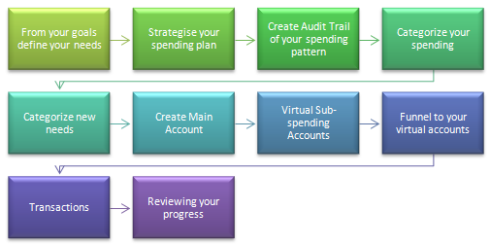
Steps to Manage Personal Finance
1. Know your expenses well
6. Have adequate insurance :
1. Life insurance (death benefit)
2. Critical illness (like heart attacks, cancers, strokes etc)
3. Hospital and surgical insurance
4. Accident plans (can include things like dengue fever)
5. Elderly care (for those who are old and have problem fulfilling some basic acts of being a healthy independent human being)
6. Disability income (if you can't work because of disability, you'll get an income for a period of time)
- Do up your net worth and cash flow, including the expenditure statements
- See where the leaks are and how to remedy them
- Set action plans on how to reach these goals
2. Pay yourself first
3. Identify your needs and wants
4. Understand and manage your debts
5. Earn more money
1. Life insurance (death benefit)
2. Critical illness (like heart attacks, cancers, strokes etc)
3. Hospital and surgical insurance
4. Accident plans (can include things like dengue fever)
5. Elderly care (for those who are old and have problem fulfilling some basic acts of being a healthy independent human being)
6. Disability income (if you can't work because of disability, you'll get an income for a period of time)
1. Have an idea on where you stand financially at this moment
- Do up your net worth and cash flow, including the expenditure statements
2. Analyze your statements
- See where the leaks are and how to remedy them
3. Set progressive goals
- Set action plans on how to reach these goals
Market Theme for 2011
Market theme for the past few months prior to end of 2010 :
Healthcare (M&A)
Oil & Gas
Basic Materials (Commodity)
Source : FTSE ST Index
Market Theme for 2011 :
mergers & acquisition
hospitality
office & industrial REIT
high-yield stocks
Source : UOB-Kayhian
commodity
energy, oil & gas
Source : SIAS
Healthcare (M&A)
Oil & Gas
Basic Materials (Commodity)
Source : FTSE ST Index
Market Theme for 2011 :
mergers & acquisition
hospitality
office & industrial REIT
high-yield stocks
Source : UOB-Kayhian
commodity
energy, oil & gas
Source : SIAS
Calendar Effect
Calender Effect is a collection of assorted theories that assert that certain days, months or times of year are subject to above-average price changes in market indexes and can therefore represent good or bad times to invest. Some theories that fall under the calendar effect include the Monday effect, the October effect, the Halloween effect and the January effect.
Most of the evidence for these effects is anecdotal, although there is a slight statistical case to be made for some of them, which is more than enough to encourage some investors to place their faith in them.
Proponents of the October effect, one of the most popular theories, argue that October is when some of the greatest crashes in stock market history, including 1929's Black Tuesday and Thursday and the 1987 stock market crash, occurred. While statistical evidence doesn't support the phenomenon that stocks trade lower in October, the psychological expectations of the October effect still exist.
CALENDER MONTH
DECEMBER
Santa Claus Rally
A surge in the price of stocks that often occurs in the week between Christmas and New Year's Day. There are numerous explanations for the Santa Claus Rally phenomenon, including tax considerations, happiness around Wall Street, people investing their Christmas bonuses and the fact that the pessimists are usually on vacation this week. Many consider the Santa Claus rally to be a result of people buying stocks in anticipation of the rise in stock prices during the month of January, otherwise known as the January effect.
JANUARY
January Effect
A general increase in stock prices during the month of January. This rally is generally attributed to an increase in buying, which follows the drop in price that typically happens in December when investors, seeking to create tax losses to offset capital gains, prompt a sell-off.
The January effect is said to affect small caps more than mid or large caps. This historical trend, however, has been less pronounced in recent years because the markets have adjusted for it. Another reason the January effect is now considered less important is that more people are using tax-sheltered retirement plans and therefore have no reason to sell at the end of the year for a tax loss.
OCTOBER
October Effect
The theory that stocks tend to decline during the month of October. The October effect is considered mainly to be a psychological expectation rather than an actual phenomenon. Most statistics go against the theory.
CALENDAR DAY
Monday Effect
A theory that states that returns on the stock market on Mondays will follow the prevailing trend from the previous Friday. Therefore, if the market was up on Friday, it should continue through the weekend and, come Monday, resume its rise.
Weekend Effect
A phenomenon in financial markets in which stock returns on Mondays are often significantly lower than those of the immediately preceding Friday. Some theories that explain the effect attribute the tendency for companies to release bad news on Friday after the markets close to depressed stock prices on Monday. Others state that the weekend effect might be linked to short selling, which would affect stocks with high short interest positions. Alternatively, the effect could simply be a result of traders' fading optimism between Friday and Monday.
The weekend effect has been a regular feature of stock trading patterns for many years. For example, according to a study by the Federal Reserve, prior to 1987 there was a statistically significant negative return over the weekends. However, the study did mention that this negative return had disappeared in the period from post-1987 to 1998. Since 1998, volatility over the weekends has increased again, and the phenomenon of the weekend effect remains a much debated topic.
Most of the evidence for these effects is anecdotal, although there is a slight statistical case to be made for some of them, which is more than enough to encourage some investors to place their faith in them.
Proponents of the October effect, one of the most popular theories, argue that October is when some of the greatest crashes in stock market history, including 1929's Black Tuesday and Thursday and the 1987 stock market crash, occurred. While statistical evidence doesn't support the phenomenon that stocks trade lower in October, the psychological expectations of the October effect still exist.
CALENDER MONTH
DECEMBER
Santa Claus Rally
A surge in the price of stocks that often occurs in the week between Christmas and New Year's Day. There are numerous explanations for the Santa Claus Rally phenomenon, including tax considerations, happiness around Wall Street, people investing their Christmas bonuses and the fact that the pessimists are usually on vacation this week. Many consider the Santa Claus rally to be a result of people buying stocks in anticipation of the rise in stock prices during the month of January, otherwise known as the January effect.
JANUARY
January Effect
A general increase in stock prices during the month of January. This rally is generally attributed to an increase in buying, which follows the drop in price that typically happens in December when investors, seeking to create tax losses to offset capital gains, prompt a sell-off.
The January effect is said to affect small caps more than mid or large caps. This historical trend, however, has been less pronounced in recent years because the markets have adjusted for it. Another reason the January effect is now considered less important is that more people are using tax-sheltered retirement plans and therefore have no reason to sell at the end of the year for a tax loss.
- Jan effect shows that from 1802-2004, Jan's return is highly than the other months for 16.9% of the time ( not very high in my opinion)
- Works best on countries with no tax on capital gains i.e Singapore ( But based on my own research from IRAS on tax laws. Apparently capital gains/loss does not affect on the individual level. It only affects companies. Hence I would think that this is more applicable to hedge funds and investment companies. By 'making a loss' this year, there are able to reduce their tax for this working year)
- Works best on small caps stock
OCTOBER
October Effect
The theory that stocks tend to decline during the month of October. The October effect is considered mainly to be a psychological expectation rather than an actual phenomenon. Most statistics go against the theory.
CALENDAR DAY
Monday Effect
A theory that states that returns on the stock market on Mondays will follow the prevailing trend from the previous Friday. Therefore, if the market was up on Friday, it should continue through the weekend and, come Monday, resume its rise.
Weekend Effect
A phenomenon in financial markets in which stock returns on Mondays are often significantly lower than those of the immediately preceding Friday. Some theories that explain the effect attribute the tendency for companies to release bad news on Friday after the markets close to depressed stock prices on Monday. Others state that the weekend effect might be linked to short selling, which would affect stocks with high short interest positions. Alternatively, the effect could simply be a result of traders' fading optimism between Friday and Monday.
The weekend effect has been a regular feature of stock trading patterns for many years. For example, according to a study by the Federal Reserve, prior to 1987 there was a statistically significant negative return over the weekends. However, the study did mention that this negative return had disappeared in the period from post-1987 to 1998. Since 1998, volatility over the weekends has increased again, and the phenomenon of the weekend effect remains a much debated topic.
Saturday, December 11, 2010
Copied from Rekindling the flame of analysing with Fundamental Analysis from 'Time To Huat!' blog :
...wouldn’t life be easier if I have a valuation model that will automatically adjust its’ value based any new earnings report. Then if the price is trading below the “valued intrinsic price” I will be looking to buy and if the price is trading above “valued intrinsic price” then I will be looking to take profit.
But the challenge is how to calculate a “valued intrinsic price”?
Let me share with you what are the various valuation models that is currently being practised in the market:
1) Dividend growth model (or known as Dividend discount model)
• Based on the discounted cash flow (DCF) concept to calculate the present value of future dividend to derive an intrinsic value. Below are the detailed explaination :
Stock Valuation Models (Part1 – NAV model)
Stock Valuation Models (Part2 – Earnings & Expected Return)
Stock Valuation Models (Part3 – Discounted Cash Flow Model)
Stock Valuation Models (Part4 – Discounted Dividend Model)
2) Capital Asset Pricing Model (CAPM)
• Based on identifying the relationship of risk (Beta) and expected rate of return which is eventually used to price risky securities
3) Graham valuation model
• Based on using earning per share (EPS) and earnings growth to derive a an intrinsic value
4) Buffet’s valuation model
• Based on using combo of Dividend Discount Model and Graham’s valuation model. (This is really new to me)
...wouldn’t life be easier if I have a valuation model that will automatically adjust its’ value based any new earnings report. Then if the price is trading below the “valued intrinsic price” I will be looking to buy and if the price is trading above “valued intrinsic price” then I will be looking to take profit.
But the challenge is how to calculate a “valued intrinsic price”?
Let me share with you what are the various valuation models that is currently being practised in the market:
1) Dividend growth model (or known as Dividend discount model)
• Based on the discounted cash flow (DCF) concept to calculate the present value of future dividend to derive an intrinsic value. Below are the detailed explaination :
Stock Valuation Models (Part1 – NAV model)
Stock Valuation Models (Part2 – Earnings & Expected Return)
Stock Valuation Models (Part3 – Discounted Cash Flow Model)
Stock Valuation Models (Part4 – Discounted Dividend Model)
2) Capital Asset Pricing Model (CAPM)
• Based on identifying the relationship of risk (Beta) and expected rate of return which is eventually used to price risky securities
3) Graham valuation model
• Based on using earning per share (EPS) and earnings growth to derive a an intrinsic value
4) Buffet’s valuation model
• Based on using combo of Dividend Discount Model and Graham’s valuation model. (This is really new to me)
Friday, December 10, 2010
Current Portfolio
My Portfolio is divided into the following :
ACTIVE PORTFOLIOS
2. LippoMapleT - LMIR
2. Annica
3. Abterra
4. China Sports
5. Penguin
6. Eunetwork
PASSIVE PORTFOLIOS
2. Ascott
3. Plife
4. Starhill Global
5. Cambridge
2. Midas
3. Ying Li
Active Portfolio is what I am actively trading / investing. Passive Portfolio is those stocks that I have with nearly $0 capital outlay.
ACTIVE PORTFOLIOS
High Yield Portfolio
1. AIMS AMPI Reit2. LippoMapleT - LMIR
Growth Portfolio
1. Raffles Edu2. Annica
3. Abterra
4. China Sports
5. Penguin
6. Eunetwork
Cyclical Portfolio
NilPASSIVE PORTFOLIOS
Yield Portfolio
1. Ascendas2. Ascott
3. Plife
4. Starhill Global
5. Cambridge
Capital Gain Portfolio
1. Innovalu2. Midas
3. Ying Li
Active Portfolio is what I am actively trading / investing. Passive Portfolio is those stocks that I have with nearly $0 capital outlay.
Thursday, December 9, 2010
FA - To Average Down or Not?
Ask the following whether to average down to accumulate or sell at loss :
1. Is the original reason for buying into the company is still valid?
2. If the reason is still valid, look at the numbers.
3. If the company is financially healthy and now trading at below what it is worth, I would look at accumulating.
4. I would then look at the charts to find a fair entry price and load up.
1. Is the original reason for buying into the company is still valid?
2. If the reason is still valid, look at the numbers.
3. If the company is financially healthy and now trading at below what it is worth, I would look at accumulating.
4. I would then look at the charts to find a fair entry price and load up.
FA - Steps to buy stocks
Steps when using FA to buy stocks :
1. Look at the sector versus the economy.
2. Look at the company's numbers to ensure
- not over-valued,
- profitable,
- not too highly geared
- has good cashflow.
3. Compare the company's numbers to its peers.
There are other things to look at in time but these 3 points form the core of my fundamental analyses.
Then, I use technical analysis (charting) to decide on fair entry points.
1. Look at the sector versus the economy.
2. Look at the company's numbers to ensure
- not over-valued,
- profitable,
- not too highly geared
- has good cashflow.
3. Compare the company's numbers to its peers.
There are other things to look at in time but these 3 points form the core of my fundamental analyses.
Then, I use technical analysis (charting) to decide on fair entry points.
Wednesday, December 8, 2010
LippoMapleT - LMIR

Volume - Even though a little bit high, but history shows that similar volume quantity in the past does not have negative effect on the price.
ADX - Possible consolidation of pricing for the next few days as ADX going past 20. Look for possible crosing of +DI upwards for and positive trending.
MACD - Moving towards 0. Momentum starting to build up.
MFI - Above 50 shows more buying interest.
Conclusion :
Looks like this counter will continue it's upward trend. However it will have a short consolidation period before resuming any further upward move.
CALL : BUY when stochastics at oversold region
TARGET : 0.505
AIMS AMP

Volume - Tapering. Might be consolidating.
Price - Formation of symmetrical triangle shows that the market is currently indecisive of where the trend is going to be.
ADX - The uptrend is still strong.
MACD - Not much momentum at this moment. But look out for sign of MACD line crossing signal line and 0, as sign of upward move.
Stochastics - Lower highs shows less buying pressure.
OBV - Not much movements
Conclusion :
CALL : HOLD but monitor for TREND
STI

Seems to be forming head and shoulders. Currently in sideways as ADX is below 20. Beware of the possible start of downward trend.
CALL : MONITOR to SELL
Abterra

MA - Closed below 50dma. Support gave way. Next support at 1.185
ADX - ADX line currently below 20, meaning that the trend is weak, in sideways at this moment. -DI (red line) is going upwards above 20, meaning that the downtrend is getting stronger and stronger.
MFI - Going down below 50% and ongoing. Less and less mass interest on this counter.
MACD - Touching 0 and going towards negative zone. Less and less momentum going on.
RSI - Touching 30 and still going downward. Estimate that the price will be going down further and stay for a while in oversold region before rebouncing.
OBV - No sign of distribution yet.
Conclusion :
All indicators showed downward bias except OBV. If OBV maintains, The downtrend will not be drastic. But if OBV becomes red within the next few days, need to cut loss.
CALL : MONITOR for SELL
TARGET : 1.285
Friday, December 3, 2010
Goals and Objectives for 2011
Well I am very disappointed after reviewing my goals for 2010. As I have been out of the market for nearly 1 year, basically no improvement compared to 2009.
Now as I will be quite active again in the market, I will define my goals and objectives for 2011.
GOALS
For 2011, I will start having 4 types of portfolios, and the goals for each are :
1. Income - Earning 5% average from dividends
2. Growth - Earning 10% average on capital gain
3. Cyclical - Accumulate 10% free units from portfolio
4. High Risk - No loss
Objectives :
1. Build up foundation for FA
2. Build up foundation for TA
3. Discipline
4. Market & portfolio review at least 50% of the time.
Now as I will be quite active again in the market, I will define my goals and objectives for 2011.
GOALS
For 2011, I will start having 4 types of portfolios, and the goals for each are :
1. Income - Earning 5% average from dividends
2. Growth - Earning 10% average on capital gain
3. Cyclical - Accumulate 10% free units from portfolio
4. High Risk - No loss
Objectives :
1. Build up foundation for FA
2. Build up foundation for TA
3. Discipline
4. Market & portfolio review at least 50% of the time.
Raffles Education
This morning saw that Raffles Education is trading at 0.255, the previous lowest during financial crisis. So I bought some to accumulate.
The current low is due to some latest poor financial results. But my estimate is that the results will be better for the next 1-2 years because quite a number of new operations will be starting soon from 2011 onwards. Furthermore, there are quite some insider buying from the market and also company share buy back recently.
Quite optimistic on this counter.
The current low is due to some latest poor financial results. But my estimate is that the results will be better for the next 1-2 years because quite a number of new operations will be starting soon from 2011 onwards. Furthermore, there are quite some insider buying from the market and also company share buy back recently.
Quite optimistic on this counter.
Thursday, December 2, 2010
CitySpring
CitySpring had been a wrong purchase since early venture into yield stock. Not much upside movement and low yield. The target price had been reduced to 0.52 sometime in October.

 ADX and intraday chart show further downside possible. So I sold all at 0.555 today at a loss of $360


LMIR
Have been monitoring LMIR since the past few days.
Why a sudden interest in it?
Current price is 0.53
Target price is higher at 0.60 (13.1% potential increase in capital)
NAV 0.79 (49% potential increase)
Yield 1.09 (8.23% pa)
Gearing 10.8% (lowest among S-REIT)
In fact I should have went in yesterday after looking at the chart, after STI & LMIR had some correction. But dally a bit due to impending head and shoulder formation in STI chart.
However, today LMIR open above the 0.525 resistance and looking at the trading activities, seems like it will be going upwards.


Noticed that some tactics are being used as there are lots of 1 lot buying sat 0.53 but selling big lots at 0.525 in the morning. Then lots of big lot buying start coming in the afternoon.
In the end bought some lots at 0.53 at 2.48pm.
Update at 5.05pm :


 Noted that after lots of 1 lots buying at 0.53, then followed by 1 big (225) lot selling at 0.525 at last minute prior to closing.
Why a sudden interest in it?
Current price is 0.53
Target price is higher at 0.60 (13.1% potential increase in capital)
NAV 0.79 (49% potential increase)
Yield 1.09 (8.23% pa)
Gearing 10.8% (lowest among S-REIT)
In fact I should have went in yesterday after looking at the chart, after STI & LMIR had some correction. But dally a bit due to impending head and shoulder formation in STI chart.
However, today LMIR open above the 0.525 resistance and looking at the trading activities, seems like it will be going upwards.


Noticed that some tactics are being used as there are lots of 1 lot buying sat 0.53 but selling big lots at 0.525 in the morning. Then lots of big lot buying start coming in the afternoon.
In the end bought some lots at 0.53 at 2.48pm.
Update at 5.05pm :


Induction Tactic
Induction tactic is done by selling at higher price (smaller quantity) then buying back at lower price (higher quantity).
The objective is to buy from weak contra holders.
The objective is to buy from weak contra holders.
Thursday, August 19, 2010

Subscribe to:
Posts (Atom)
